
Why Does Pricing Strategy Start From Scratch on Every Bid?
GovCon pricing teams keep solving the same problems by hand, even though the market is full of public data that can help. HXG1 was built to turn that data into repeatable pricing intelligence.
Our team has spent years as pricing analysts and PTW strategists for government contractors, and one pattern became impossible to ignore: every new pursuit was treated like a fresh analytical problem, even when the underlying pricing questions had appeared before. The same rate logic was reconstructed. The same competitive questions were debated. The same comparable contracts were searched for. The same judgment calls were made under pressure, with incomplete information and too little time.
The problem is not a lack of expertise. It is a lack of scalable market intelligence. Government contracts produce an enormous amount of public data, from procurement documents through spending records, but no analyst can manually review enough of it to see the full pattern on every pursuit. The data exists. The challenge is making it usable.
We built HXG1 to solve that problem. It is pricing-strategy infrastructure for government contractors, built to uncover market signals that are difficult to detect manually, so teams get an analytical starting point grounded in market-scale data rather than starting from scratch. Here is what drove us to build it.
Pricing Decisions Start Before Pricing Analysis Begins
The most consequential pricing decisions don't happen while you're writing the proposal. They happen far earlier in the capture lifecycle: bid/no-bid decisions, customer meetings, teaming discussions, competitive assessments, solutioning sessions, and early win-strategy decisions.
Small differences in how price will be evaluated can have an outsized effect on the entire strategy. The pricing experts are often unavailable or allocated elsewhere during early capture. Capture managers are leading the pursuit, but they are not always equipped to analyze the pricing evaluation mechanics in detail.
Almost every choice you make pre-proposal has a price consequence, whether or not anyone is running the numbers yet. By the time rigorous pricing analysis shows up, solution and teaming decisions may already be locked in, and you've already lost your best levers to change your price.
HXG1 puts defensible pricing intelligence into the process earlier, so the people shaping the pursuit can understand the likely price consequences of their decisions while those decisions are still flexible.
The Baseline Changes Depending on Who Builds It
Give the same opportunity to two different capture teams and you can get meaningfully different answers. Sometimes it's because one voice on the team is louder than the others. Every pricing leader has run into the execution-focused PM who is very good at explaining why salaries need to be higher. But often the problem is simpler: it is hard for any analyst to make consistent decisions without a shared baseline.
The process depends heavily on individual judgment: which benchmarks to trust, how to interpret labor requirements, how to evaluate competitor behavior, how to model evaluation and execution risk, and how to translate all of that into a price.
Judgment is necessary. But judgment without a shared analytical baseline creates drift. That is not a people problem. It is a systems problem.
HXG1 automates analytics to give teams a consistent baseline for pricing decisions: a common analytical starting point that can be reviewed, challenged, and adjusted as the team learns more about the opportunity. The final pricing call still depends on expert judgment, but the strategy starts from the same evidence base.
Comparables Are Too Valuable to Be a Scavenger Hunt
One of the most valuable inputs to any pricing decision is knowing what comparable work has been awarded at in the past. Looking at comparable contracts lets you understand both your customers and your competitors.
But in practice, comparables are hard to find. Relevant information may be scattered across desktops, emails, shared drives, SharePoints, contract files, and the memories of people who may have left the company. Finding a useful comparable often depends on knowing who worked the pursuit, hoping they saved the analysis, and hoping the old file is still understandable when someone opens it.
That is not a scalable way to run pricing strategy. Comparable contracts should be an analytical input, not a scavenger hunt.
HXG1 makes contract history searchable, structured, and usable. It identifies which prior awards are actually relevant, based on customer, scope, labor structure, contract type, evaluation mechanics, competitive context, and pricing behavior. A comparable is only useful if the team understands why it is comparable, and how they can use it to make a decision on the next deal.
Public Data Is Valuable, But Noisy
The government market produces a vast amount of public data, but a lot of it is unusable.
Spending records are inconsistent. Descriptions are messy. Award values can reflect ceiling amounts, exercised values, funded obligations, or partial task-order structures. Labor information may sit in separate sources with different definitions and time periods. Periods of performance can be hard to interpret. Incumbent relationships may require multiple records to reconstruct. Evaluation mechanics often live in solicitation documents, pricing templates, amendments, or Q&A files rather than in any single structured database.
That means the hard part is not simply collecting data. The hard part is interpreting it correctly, connecting it across sources, and understanding which signals actually matter for the pricing decision in front of the team.
We built HXG1 around that interpretation problem. Pricing SMEs label and structure public market data so the models can recognize the distinctions that matter in real pricing work: which records are meaningful, which values are misleading, which contracts are actually comparable, and which evaluation structures create room for more aggressive pricing. That expert-labeled foundation converts fragmented market information into structured pricing intelligence.
At Portfolio Scale, Pricing Patterns Become Visible
Individual government contracts often look bespoke. The scope, customer, incumbent, and evaluation criteria are unique.
But at portfolio scale, pricing behavior is patterned.
Across enough awards, recurring relationships become visible: between contract structure and pricing flexibility, between labor economics and award price, between evaluation mechanics and price aggressiveness, between incumbent dynamics and competitive positioning, between workforce composition and plausible price range.
No analyst reviewing one opportunity at a time can reliably see those patterns. They span too many variables across too many contracts. That is where a computational approach becomes necessary.
Models built on public contract data, labor-market economics, pricing structures, and market outcomes can identify signals that are difficult for a human team to detect through intuition alone. Not because the team is not capable, but because the relevant signal exists at a scale no individual analyst can hold in mind.
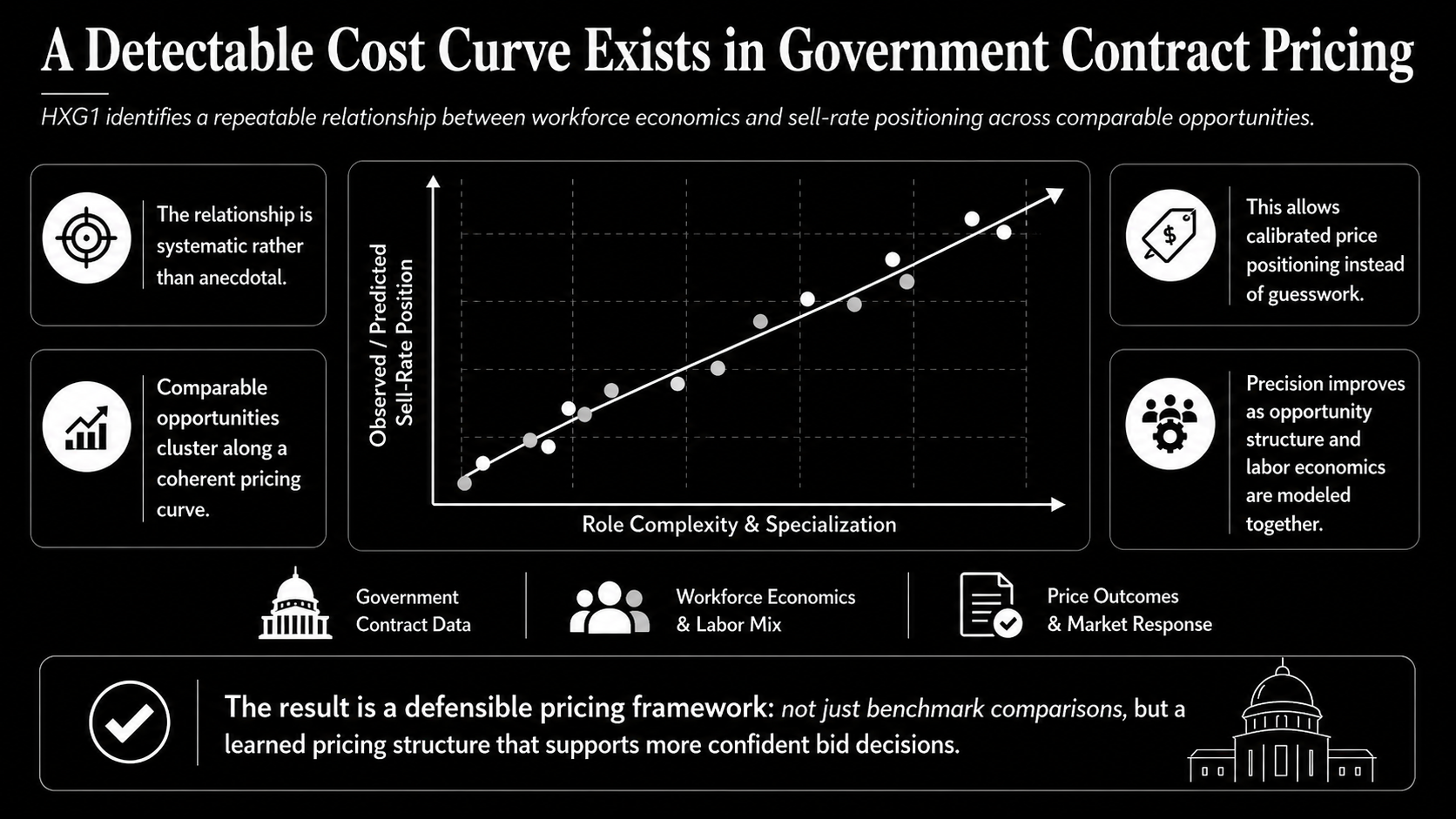
That is the immediate lift HXG1 provides. It gives teams access to a highly accurate market baseline that has already been modeled from open-source data.
Customer-specific history then adds something different: local context. By focusing on your customer's opportunities, the data can reveal conditions that are too specific to show up cleanly in the broader market baseline: how a particular BPA tends to price, how a specific program office evaluates tradeoffs, how an incumbent behaves on a recompete, or how your own solutioning choices have performed on that account before.
Competitive Intelligence Should Be Cumulative
Most organizations have a general sense of who they compete against and how those competitors behave. But that knowledge is anecdotal. It lives in debriefs, hallway conversations, capture notes, and the memories of people who have seen the same competitors before. After an award or a loss, the competitive dynamics that shaped the outcome get discussed briefly and then effectively disappear. The organization may learn something, but the system does not.
If a competitor consistently prices aggressively in one type of work but behaves differently in another, that pattern should become part of the organization's pricing knowledge, not something that has to be re-discovered on every pursuit.
HXG1 treats competitive intelligence as structured data, not disposable conversation. It connects what teams know about agencies, incumbents, competitors, labor markets, and award outcomes into a pricing view that carries forward across pursuits.
What HXG1 Makes Possible
The problems described above emerge when pricing is handled without a system: knowledge stays fragmented, public market data remains difficult to interpret at speed, timing works against the team, and there is no clear bridge between what the organization could know and what it does next.
HXG1 brings the pieces together. It gives capture and pricing teams a consistent, data-grounded view of where pricing should land for a given opportunity, calibrated against real contract data, workforce economics, evaluation mechanics, competitive dynamics, and historical outcomes. It does not replace the people responsible for making difficult tradeoffs. It gives them better inputs, earlier in the process, with a defensible rationale underneath.
If your team is still rebuilding pricing strategy one bid at a time, we would be glad to show how HXG1 creates a more consistent analytical starting point.